
“], “filter”: { “nextExceptions”: “img, blockquote, div”, “nextContainsExceptions”: “img, blockquote, a.btn, a.o-button”} }”>
Welcome to the Urbanist Update. My primary work here might be as a tech editor, but I’ve also spent tons of time studying transportation, city planning, and engineering. Here are some of the things I’ve found interesting over the past week related to biking in cities, cycling infrastructure, and urbanism.
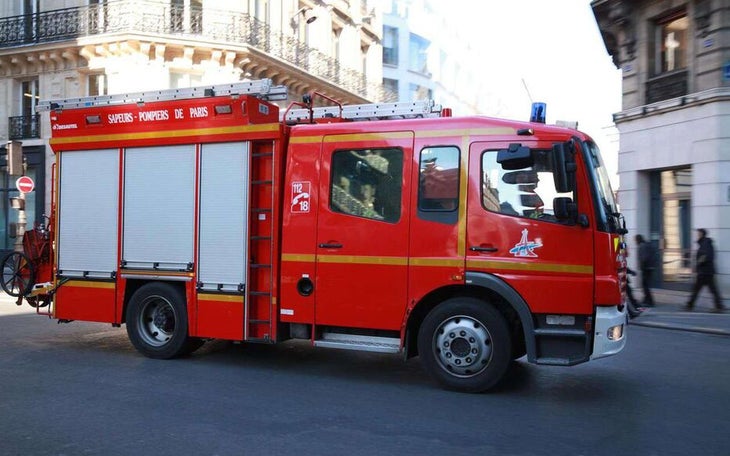
A fire engine moving through Paris. (Image: LP/Olivier Boitet)
In Paris, the firefighters’ response time has shortened: ‘In an emergency, one minute counts’
More and more cities in North America are using separated bike lanes, which are lanes exclusively used for people biking that are either in or adjacent to a street or road. These are generally in or adjacent to the curb and allow movement in one direction.
Cities that want to level up will create a two-way lane wide enough for someone biking to pass in either direction or for a faster cyclist to pass a slower-moving one. But the city of Paris, France takes it a step further: their bike lanes are wide enough for emergency vehicles, at least according to a story in Le Parisien.
Paris has gone to great lengths to invest in their bicycle infrastructure, no small task in the city. But because the French capital’s bike lanes in some places are so wide, firefighters can use them to get around car-induced congestion.
The result? Average firefighter emergency response times have fallen below seven minutes, down from a max of 7 minutes and 46 seconds before the global Covid-19 pandemic.
This isn’t to say wide bike lanes are the proper treatment everywhere, as few cities have quite the density of Paris. American fire trucks are also considerably larger than what one might find in France. But designing future roads to have properly wide separated bike lanes now can future-proof cities, both for transportation and emergency services alike.
 (Image: YoGo Bikeshare)
Interview: What Does It Take To Start Your Own Bikeshare?
Your city might have a bike share program, which consists of bikes around a city area that allow people to rent a bike from one location and return it to another. Most U.S. bike share systems are found in large cities and maintained by either corporate donations or federal grants.
Not the case for YoGo Bikeshare in Youngstown, Ohio, where a black-led, family-owned bikeshare is trying to get a town of 60,000 people on electric bikes.
Streetsblog interviews in a podcast the founders of YoGo to learn more about how their bikeshare system works and what kind of challenges they face. Turns out that maintaining a fleet of electric bikes isn’t easy, and marketing it in a smaller U.S. city is even more challenging.
 Woman commuting to work on electric bike share bike (Image: Getty Images)
How to get more women on bikes? Better biking infrastructure, designed by women
One large component in the fight for bicycle infrastructure is fighting for public equity. As it stands, streets and roads are overwhelmingly designed only with cars in mind, and rarely for folks walking, biking, or otherwise. But even within biking infrastructure is another equity disparity to be solved: cycling is dominated by men.
A recent study, first highlighted in The Conversation, found that women experience gendered barriers to riding a bike that men don’t. Inadequate or non-existent lighting, infrequent community use of cycling spaces, bike paths detouring into dark underpasses, and others were highlighted as barriers to women cycling.
While e-bikes might help folks feel more comfortable keeping up with traffic, their high prices make them cost-prohibitive.
The study focuses on a group of people in Melbourne, Australia, but the issues highlighted still stand in other parts of the world. A fight for equity means that there should be equity in the decision-making processes as well as representation of women and other oft-marginalized groups. Put simply, if you want bike lanes to be used in your city, involve more women.
 (Image: City of Amsterdam)
Amsterdam just opened new underwater parking lots for 11,000 bikes
Amsterdam, where more bikes are found underwater than any other city in the world, has now doubled down with underwater parking. It’s basically the same thing, but rather than your bike rusting through, it’s in a secure parking space that happens to be underwater.
The underwater parking structure, found at Amsterdam’s Centraal Station, has space for 11,000 bicycles. And as wild as that number is, an estimated 200,000 travelers arrive every day. Half of those travelers arrive by bicycle.
Amsterdam is overflowing with bikes and a busy bike parking area like that of the outdoor space in front of Centraal Station can be best described as a chaotic morass. The underground parking structure allows people to use a chipped tag to find their bike amongst the thousands stored away each day.
YouTube channel Not Just Bikes has my personal favorite video tour of the new bicycle parking garage. Check it out, but for your mental health, make sure you don’t compare it to the bike parking at your local train station.
Hey @CityofVancouver this is second incident I’ve seen caused by these useless ‘slow street’ barricades installed last month. They don’t slow down traffic; they cause crashes and traffic chaos. pic.twitter.com/A4xZOwMCGi
— Jill Bennett (@jillreports) March 23, 2023
Bike infrastructure at work 🥰
Last week, Vancouver-area radio host Jill Bennett went viral after tweeting a photo of a Dodge Durango straddling a bright yellow concrete barrier that the driver had hit.
“Hey @CityofVancouver this is second incident I’ve seen caused by these useless ‘slow street’ barricades installed last month. They don’t slow down traffic; they cause crashes and traffic chaos,” Bennett wrote.
I am of the opinion that cars can coexist with people biking. But if this tweet – which blames bicycle-centric infrastructure for the crash – is any indication, I’m not sure cars and their drivers can do that safely if they’re crashing into stationary traffic calming measures like this one.