
“], “filter”: { “nextExceptions”: “img, blockquote, div”, “nextContainsExceptions”: “img, blockquote, a.btn, a.o-button”} }”>
Heading out the door? Read this article on the new Outside+ app available now on iOS devices for members!
>”,”name”:”in-content-cta”,”type”:”link”}}”>Download the app.
Throughout this Tour de France, longtime cycling journalist John Wilcockson is writing about the riders who have to abandon the race: The Lost Boys. Today, he looks at the challenges faced by Phil Bauhaus, Simon Geschke, Wout van Aert and Anthony Perez—and how another rider overcame what seemed like insurmountable odds.
—-
With the 110th Tour de France nearing its end, no one wants to drop out. Even if a rider is suffering from wounds or sickness or simply chronic fatigue, he still fights to his last gram of energy. One rider who did this through the Alps is Frenchman Adrien Petit, the Intermarché-Circus-Wanty team captain and lead-out rider for Biniam Girmay.
Petit, who’s been struggling with injuries all week, put out this tweet on Wednesday morning (above a photo of the monster stage 17 profile taped to his bars): “Why do I continue the Tour de France? Because I respect this race. I always finished it. The fans applauding me are important. I need to survive.”
While Petit did get through stage 17 and its 18,000 feet of climbing, another rider, the Bahrain Victorious team’s German field sprinter Phil Bauhaus, did not. After taking his third top-three of the Tour at Moulins on July 12, Bauhaus struggled on each of the following five stages, finishing around 150th every day. On Wednesday, he again had a hard time keeping up with the pace.
Even though the stage began with 5 kilometers of uphill to a plateau, the average speed for the first 15 kilometers was 51.2 kph. Then came the Cat. 1 Col des Saisies. Bauhaus was already dropped and by the time he got over that mountain to the intermediate sprint at Beaufort with 120 kilometers still to ride over three more passes he was already nine minutes behind.
To do that alone in his fatigued state and finish within the time cut would have been impossible.
Opting to end his Tour at Beaufort was really Bauhaus’ only choice. That was emphasized four and a half hours later when the last man to finish the stage, just before the time cut, was the German veteran Simon Geschke, a climber who won a Tour stage not far from here at Pra Loup eight years ago. Furthermore, this was Bauhaus’ Tour debut.
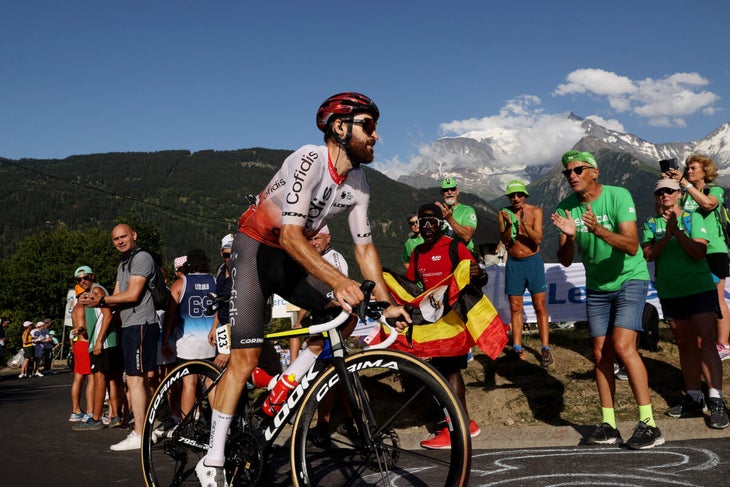
Simon Geschke (Team Cofidis) in action on stage 15, four days before he had to stop the Tour de France. (Photo by Michael Steele/Getty Images)
After crossing the line alone, Geschke was helped off his bike, a soigneur removed his helmet and sunglasses before he sat crossed-legged for a moment and then fell back onto the hot tarmac with his hands clasped over his sweat-covered face.
“Didn’t see that nightmare of a day coming,” Geschke later tweeted. “Don’t know if I ever had a harder day on the bike.”
He was hoping that he could recover from that super-human effort to continue, especially as the 37-year-old German has started (and finished) each of the past 10 Tours de France. But Geschke, who has a vegan diet, had stomach issues overnight and couldn’t keep food down.
And as soon as he started Thursday’s stage 18, he reported that his “legs were just completely empty.” Even so, he stuck with the peloton for the opening 60 kilometers, on mostly downhill roads, until he was dropped on the short hill out of Chambéry.
He caught back on but was dropped again on the day’s second Cat. 4 climb. With 80 kilometers still to ride and no fuel left in the tank, Geschke reluctantly stopped.
Men like Geschke and Petit exemplify the courage of riders who continue racing in the Tour when all the odds seem to be against them. Such was Petit’s courage of gritting his way through the Alps that after stage 15 he was called to the podium to be given the most combative rider award—instead of it going to a rider who did the most attacking at the front of the race.
It is indeed difficult to understand how Petit overcame incomprehensible pain to hang on to the last group of riders for hour after hour on three of the Tour’s most challenging mountain stages.
Describing how he was injured in the big pileup early on stage 14, Petit wrote on his blog for Radio France Internationale: “It was very fast on a descent under a light rain, riders in front skidded. I didn’t want to touch the brakes, but I shifted into an echelon [of riders], did a somersault and landed in a ditch fill of stones.
“Nothing was broken but my shorts were ripped, I had a hematoma as big as a tennis ball on my tibia and had open wounds all over. As the race was neutralized, I was treated for 10 minutes and set off with huge bandages.”
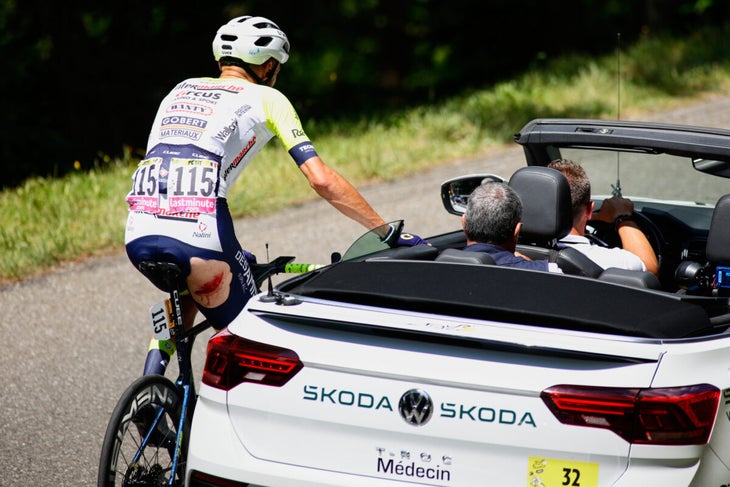 Adrien Petit from France of Intermarché – Circus – Wanty being attended by the medical staff
after crashing during stage fourteen of the 110th Tour de France 2023. (Photo by Joan Cros Garcia – Corbis/Getty Images)
Even though he could barely pedal with his right leg, Petit said, “I gritted my teeth for the next 150 kilometers over five mountains.” He made it to Morzine before the time cut, but added, “I was only at the start of my ordeal. I barely slept that night because of the open wounds, the skin burns and aches all over.
“I was bruised all over: my pelvis was a mess, same with the ribs, the cervix, the ankles. Sunday morning another big mountain stage [and] after just a few kilometers I was off the back. That was hard…to see the Tour disappear.
“This time, I had some luck because of others’ misfortune: a new crash slowed the peloton and let me hitch back on the wagon. Even so, it was the worst day in my career.”
While Petit looks like he will reach the Tour finish in Paris on Sunday, two others left the race before starting Thursday’s stage 18. This was due to personal issues. Wout van Aert of Jumbo-Visma returned home to Herentals in northeast Belgium to be with his wife Sarah at the birth of their second child; and Anthony Perez of Cofidis went back to his home near Toulouse in southern France because of a serious personal problem.
“It’s simply a family [issue],” he told La Dépêche Thursday evening, “and I want it to remain private.” He added that his emotions were such that he “couldn’t get on a bike this morning.”
With their departure, this Tour has said goodbye to 25 “lost boys” while 151 others remain.
Also read:
- The Lost Boys: Four leaders fall on stage 14 of the Tour de France
- Lost Boys: Esteban Chaves, David de la Cruz, and Antonio Pedrero with unwanted exits
- Lost Boys: The ‘nearly’ men
- See the full series here.
* * *
THE LOST BOYS
Stage 1: Enric Mas (Movistar Team), DNF
Stage 2: Richard Carapaz (EF Education-EasyPost), DNS
Stage 5: Jacopo Guarnieri (Lotto-Dstny), DNS; Luis León Sánchez (Astana Qazaqstan), DNS
Stage 8: Mark Cavendish (Astana Qazaqstan), DNF; Steff Cras (TotalEnergies), DNF
Stage 9: Quinn Simmons (Lidl-Trek), DNS
Stage 12: Fabio Jakobsen (Soudal-Quick Step), DNS; David de la Cruz (Astana Qazaqstan), DNF
Stage 13: Caleb Ewan (Lotto-Dstny), DNF; Ben Turner (INEOS Grenadiers), DNF
Stage 14: Louis Meintjes (Intermarché-Circus-Wanty), DNF; Antonio Pedrero (Movistar), DNF; Esteban Chaves (EF Education-EasyPost), DNF; Ramon Sinkeldam (Alpecin-Deceuninck), DNF; Ruben Guerreiro (Movistar), DNF; Romain Bardet (dsm-firmenich), DNF; James Shaw (EF Education-EasyPost), DNF
Stage 15: Dani Martínez (INEOS Grenadiers), DNS
Stage 16: Matteo Jorgensen (Movistar Team), DNS
Stage 17: Alexis Renard, (Cofidis), DNS; Phil Bauhaus (Bahrain Victorious), DNF
Stage 18: Anthony Perez (Cofidis), DNS; Wout van Aert (Jumbo-Visma), DNS; Simon Geschke (Cofidis), DNF