
“], “filter”: { “nextExceptions”: “img, blockquote, div”, “nextContainsExceptions”: “img, blockquote, a.btn, a.o-button”} }”>
Heading out the door? Read this article on the new Outside+ app available now on iOS devices for members!
>”,”name”:”in-content-cta”,”type”:”link”}}”>Download the app.
In this column, we dive into the time-trialing ability of Sepp Kuss, Jonas Vingegaard, and Primož Roglič at the Vuelta a España.
When Sepp Kuss took the red jersey after winning Stage 6 of the Vuelta a España, most still doubted his GC potential. But as the race wore on, the American solidified his lead, and by the time the peloton reached Madrid, Kuss had won the Vuelta a España.
The result came as a shock for many reasons: Kuss was riding his third Grand Tour of the year. Jumbo-Visma went 1-2-3 in the Veulta’s General Classification (Kuss, Vingegaard, and Roglič) and swept all three Grand Tours this year. And Kuss hung onto the overall lead for 15 stages, even when his teammates dropped him on the ultra-steep Angliru.
Also read: Sepp Kuss is the king of the KOMs
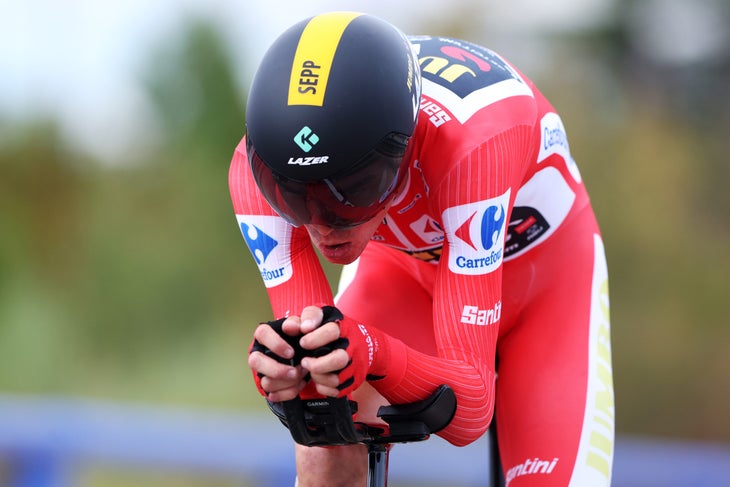
But one of Kuss’ most impressive rides came all the way back on Stage 10 in the 25.8km time trial (TT) in Valladolid. Excluding mountain TTs, Kuss had only finished in the Top 30 of a TT once in his entire career at the World Tour level.
On Stage 10, many expected Vingegaard and Roglič to blow Kuss out of the water and take back the GC lead. But Kuss did more than hold his own, finishing just 11 seconds slower than Vingegaard and 53 seconds behind Roglič.
In this article, we’re going to take a closer look at the Stage 10 TT in Valladolid and analyze how the Vuelta might have changed had the TT been a few kilometers longer.
Stage 10 TT Analysis
First, let’s take a look at the stage results so that we know where everyone stood following Stage 10’s time trial.
Stage results:
1. Filippo Ganna 27:39
2. Remco Evenepoel +0:16
3. Primož Roglič +0:36
–
10. Jonas Vingegaard +1:18
–
13. Sepp Kuss +1:29
GC standings after Stage 10:
1. Sepp Kuss 35:52:38
2. Primož Roglič +1:09
3. Jonas Vingegaard +2:22
Before we get into the hypotheticals, we first have to look at Kuss’ TT performance. In truth, it was one of the best time trials of his professional career. The American is (or was) known as a pure climber. In order to beat the best in the world, Kuss needed a steep and long climb to the finish.
Time trialing, especially on flat terrain, has never been Kuss’ strong suit. He’s said in interviews that the more he focuses on time trialing (i.e., riding his TT bike more in training), the worse he gets at time trialing.
The day before the Stage 10 TT, Kuss said that the last time he was in the wind tunnel was a few years ago. He then said that he’d only ridden his TT bike five times this year: 2 Giro TTs, 1 Tour de France TT, a TT training session before the Vuelta, and the Stage 1 Vuelta team time trial. The more time and energy he puts into his time-trialing ability, the worse he gets, Kuss said.
Needless to say, there were few who expected this result from Kuss. At T1, roughly halfway through the time trial, Kuss was in 12th place, 30 seconds slower than Roglič and 15 seconds off Vingegaard.
Kuss – T1
Time: 14:53
Average Speed: 51.2 kph
By T2, Kuss had fallen 40 seconds behind Roglič, but he actually closed the gap to Vingegaard, now just 13 seconds behind.
Kuss – T1 to T2
Time: 7:34
Average Speed: 52.4 kph
At the finish line, Kuss finished 13th, 53 seconds slower than Roglič and 11 seconds slower than Vingegaard.
Kuss – T2 to Finish
Time: 6:36
Average Speed: 56 kph
Kuss lost 2.05 seconds per kilometer (s/km) to Roglič during Stage 10 at a very even pace. However, he actually closed the gap to Vingegaard, who might have gone out a bit too hard. In the end, Kuss lost 0.43 seconds to Vingegaard per kilometer, which is equivalent to a speed difference of only 0.35 kph.
What if the TT was 10km longer?
Using these numbers (2.05 s/km and 0.43 s/km), we can estimate the amount of time that Kuss might have lost to Roglič and Vingegaard if the time trial was 10km longer.
2.05 s/km x 10km = 20.5 additional seconds lost to Roglič
0.43 s/km x 10km = 4.3 additional seconds lost to Vingegaard*
*Since Kuss was closing the gap to Vingegaard, it’s difficult to say who would’ve been faster had the TT been longer
Let’s remind ourselves of what the GC standings looked like after Stage 10.
GC standings after Stage 10:
1. Sepp Kuss 35:52:38
2. Primož Roglič +1:09
3. Jonas Vingegaard +2:22
If the Stage 10 time trial was 10km longer, Kuss still would have been 49 seconds ahead of Roglič and more than two minutes ahead of Vingegaard. In fact, at a rate of 2.05s/km, it would have taken 59.5km for Kuss to lose the GC lead to Roglič. You’d have to go back more than a decade to find an ITT longer than 59.5km in a Grand Tour.
What does this mean for Sepp Kuss as a future GC rider?
After his victory in the Vuelta, many are talking up Kuss as a future Tour de France contender. The Tour typically has more than 25.8km individual time trial kilometers, but the 2023 Tour only had 22.4km – that was Vingegaard’s greatest time trial ever, where he beat everyone but Tadej Pogacar by more than three minutes.
With a route that suits him, there’s no doubt that Kuss can be a Tour de France contender. Even in a flat time trial, he lost less than a minute to most of his GC rivals. In fact, the only riders more than a minute faster than Kuss were the two fastest time trialers in the world: Filippo Ganna and Remco Evenepoel.
Of course, if Stage 10’s time trial was longer, things could’ve been different. But you could say the same thing about 100 different situations in this year’s Vuelta.
If Kuss hadn’t been playing team tactics, he might have been able to stay with Vingegeaard on the Col du Tourmalet. Or if the GC group hadn’t fanned across the road on Stage 16, maybe Vingegaard wouldn’t have gained over a minute on Kuss in a single climb.
And if Kuss hadn’t slowed down to high-five all those fans during his win on Stage 6, he could’ve gained a few more seconds in the GC. But that’s what we love about Sepp Kuss. He is both humble and professional, likable and feared. For American cycling fans, there’s no one else we’d rather see winning the Vuelta a España.
Power Analysis data courtesy of Strava
Strava sauce extension
Riders: Sepp Kuss