
“], “filter”: { “nextExceptions”: “img, blockquote, div”, “nextContainsExceptions”: “img, blockquote, a.btn, a.o-button”} }”>
Heading out the door? Read this article on the new Outside+ app available now on iOS devices for members!
>”,”name”:”in-content-cta”,”type”:”link”}}”>Download the app.
A double ascent of the Monte Grappa, the Stelvio, two time trials, and a gravel stage will all feature in the 2024 Giro d’Italia.
Organizers RCS unveiled the route for next year’s corsa rosa in Trento on Friday evening, with several former champions in attendance.
Primož Roglič won the 2023 Giro d’Italia, beating Geraint Thomas after a tense time trial up Monte Lussari on the penultimate day.
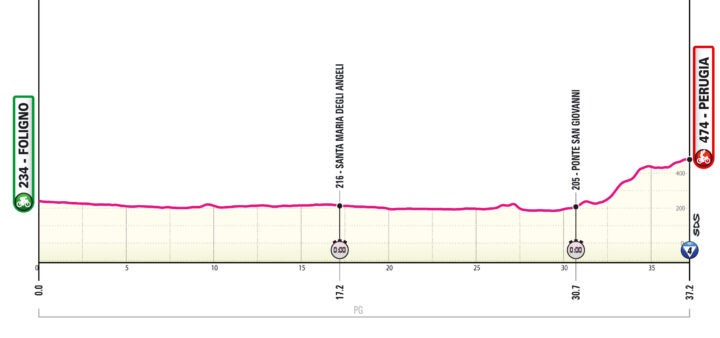
Among the notable details of the 2024 race route was a tough first week that will see the opening summit finish come as early as stage 2, a stage 6 that features three gravel sectors, plus a challenging 37.2km ITT that finishes with a tough climb to the line.
Also read: Pogačar-to-Giro Speculation Builds Ahead of Giro d’Italia, Tour de France presentations
In total, there are seven finishes on classified climbs, including the time trial. Prato di Tivo, which is in the Giro d’Italia for only the second time, is one of those, as is Livigno — a place where many riders take in altitude training.
As always, there is a tough final week with plenty of climbing, including a penultimate stage that sends the riders up the Monte Grappa not once but twice before a long descent to the finish line. The Stelvio also features in the opening stage of the last week of racing and is this year’s Cima Coppi.
A tricky first week
The first time trial of the 2024 Giro d’Italia finishes with a climb (Photo: RCS Sport)
The 2024 Giro d’Italia will take place from May 4 to May 26 next year, departing from Piedmont for the fourth time in the race’s history.
Four stages will start in the region, beginning with a rolling opener from Venaria Reale to Torino. The 136km route features three classified climbs, including the key second category Colle Maddalena, which comes 20km from the finish and could create a surprise first pink jersey of the race.
There’ll be no hanging around for any prospective GC riders, with the first summit finish arriving on day two at the Santuario di Oropa, having started in San Francesco al Campo. The Santuario di Oropa finale is synonymous with Marco Pantani after the Italian made a spectacular comeback in 1999 to win on the climb after suffering a mechanical.
The differences are unlikely to be big here, but it will be an early opportunity to see how the GC riders are going and an opportunity for the maglia rosa to change hands.
Following the first summit finish, the sprinters will finally get a chance with a flat stage 3 from Novara to Fossano. However, it’s not so straightforward, with an uphill finish providing a sting in the tail.
Day four sees the race leave Piedmont, but only after starting in Acqui Terme. The ride to Andora crests in the 1,000m Colle del Melogno in the middle before taking the peloton into Milan-San Remo territory along the Ligurian coast. It stops short of climbs such as the Cipressa and the Poggio, but it will head over the first of the three Capi, the Capo Mele.
The race then goes back on itself, bringing the riders to Genoa for the start of stage 5. The 176km route travels largely along the coast on its way to Lucca, heading over a third- and fourth-category climb — the latter of which comes about 20km from the finish — before what should be a sprint of some kind.
Stage 6 will be one of the most challenging of the first week for many of the general classification riders as it packs in three sectors of gravel, totaling 11.6km of the white roads between Viareggio and Rapolano Terme. Days like this can throw a rider’s overall ambitions into awry very quickly, with mechanical issues a big possibility.
The rolling nature of the stage and the uphill grind to the line add an extra challenge that could be too much for some and we may see some riders eliminated from the GC on this day.
With big climbs, gravel, and sprints already in the bag during the first week, stage 7 is the first time trial of the race. The long 37.2km ride from Foligno to Perrugia is the first of two TTs and features a fast opening sector combined with a climb to the finish.
Helping to close out the opening week of racing is a short, mountainous stage from Spoleto to Preti di Tivo. Stage 8 is the first five-star parcours of the race, with three classified climbs along the route, including the summit finish to Prati di Tivo.
The final ascent to the line covers 14.5km with an average gradient of seven percent and a maximum of 12. While Prati di Tivo has become a well-known climb thanks to its regular appearances in Tirreno-Adriatico, it has only once featured in the Giro d’Italia. That happened in 1975, on stage 3, with Giovanni Battaglin taking the win before spending the first of two stints in the pink jersey.
A sprint stage rounds out the first week of racing, but, as ever with the Giro d’Italia, it won’t be straightforward, and a series of unclassified hills in the final kilometers could cause problems for some.
The second week opens with a bang
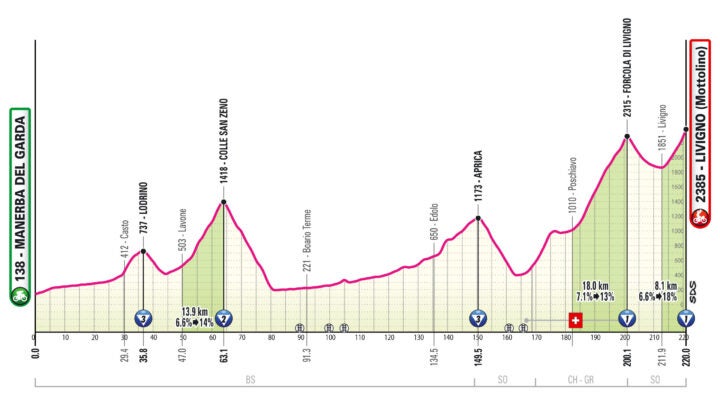 Stage 15 brings the riders over 2,000m (Photo: RCS Sport)
If the riders were hoping for an easing into the second week, they’ll be sorely disappointed as a big mountain stage awaits following the first rest day. The 141km stage starts in the historic city of Pompeii and brings the riders over the second-category Camposauro climb before a tough summit finish at the Bocca della Selva — a 17.9km climb with peaks of 10 percent.
Having had very few chances in the opening week, there are then three consecutive stages that could end up in a sprint. Stages 11, 12, and 13 all look like they’ll end in a gallop to the line of some kind, though the rolling stage 12 could eliminate any pure sprinters that turn up.
The next opportunity for the GC riders comes on stage 14 from Castiglione delle Stiviere to Desenzano del Garda with the second of the two time trials. It’s shorter than the first at 31km and will favor the specialists a bit more with only a small amount of undulating compared to the uphill finale of the first week.
Bringing the second week to an end on stage 15 is another big mountain day and a trip into Switzerland. Setting out from Manerba del Garda, the riders will tackle five classified climbs, the first two of which come in the opening 60km of the 220km day.
The stage passes through Aprica, a place that has regularly hosted Giro d’Italia finishes, before crossing the border into Switzerland. For the first time in the race, the riders will go over 2,000 meters — not once but twice — with the Forcola di Livigno and then onto Livigno itself.
It is by far the sternest test so far for the peloton, and will see another shake-up in the GC after the TT the previous day.
A double Grappa for the peloton
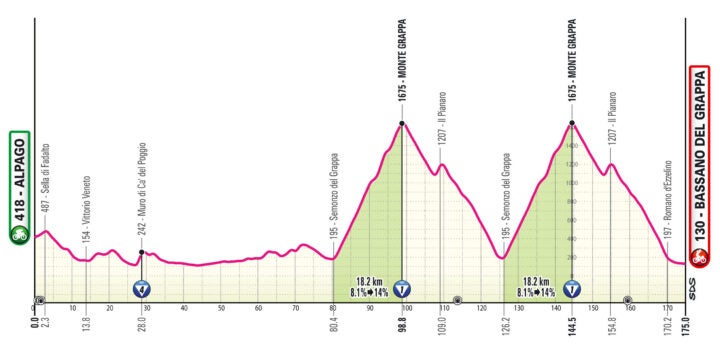 The GC fight concludes with two climbs of the Monte Grappa (Photo: RCS Sport)
It wouldn’t be a Giro d’Italia if it weren’t backloaded with plenty of big climbing, and the 2024 race is no different, with four of the final six stages going through the mountains.
Another nasty start to the week awaits the riders as the riders head out of Livigno and descend to around 1,300 meters before tackling the mighty Passo di Stelvio — next year’s Cima Coppi at a breathless 2,758 meters.
The Stelvio peaks out just over 50km into the stage, and the riders face a long descent into the valley. The day closes out with two climbs back-to-back over the Passo Pinei and the finish on the second-category Santa Cristina Valgardena.
With the Stelvio coming so early, it could be a day for the breakaway to win, but it depends on how the GC riders want to tackle it.
A sawtooth parcours sits before the riders on stage 17 from the Selva di Val Gardena to the Passo del Brocon. Across the 159km, the riders are either climbing or descending, and it could be a good day for a straggling GC team to try and mount a raid with the potential to explode the race.
There are some sprint chances in the final week, and stage 18 from Fiera di Primiero to Padova is the first of two. It’s into the medium mountains for stage 19 from Mortegliano to Sappada, with a series of second- and third-category climbs coming at the backend of the day.
A double ascent of the Monte Grappa will be the last chance for the GC men to try and climb up the rankings. After a fairly benign start, the riders will complete a loop that sees them make back-to-back climbs of the Monte Grappa before a long descent to Bassano del Grappa for a fast finale.
The 2024 Giro d’Italia will then close in the same way that it did this year with a sprint finale in Rome, something to entice the sprinters to go the full distance.
2024 Giro d’Italia route — May 4 to May 26
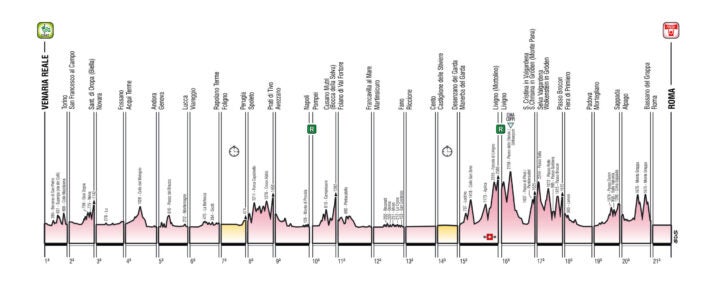 The stage profiles (Photo: RCS Sport)
Stage 1: Venaria Reale to Torino, 136km
Stage 2: San Francesco al Camp to Santuario du Oropa, 150km
Stage 3: Novara to Fossano, 165km
Stage 4: Acqui Terme to Andora, 176km
Stage 5: Genoa to Lucca, 187km
Stage 6: Viareggio to Rapolano Terme, 177km
Stage 7: Foligno to Perugia, 37.2km (ITT)
Stage 8: Spoleto to Prati di Tivo, 153km
Stage 9: Avezzano to Napoli, 206km
Rest day
Stage 10: Pompeii to Cusano Mutri, 141km
Stage 11: Foiano di val Fortore to Francavilla al Mare, 203km
Stage 12: Martinisicuro to Fano, 183km
Stage 13: Riccione to Cento, 179km
Stage 14: Castiglione delle Stiviere to Desenzano del Garda, 31km
Stage 15: Manerba del Garda to Livigno, 220km
Rest day
Stage 16: Livigno to Sana Cristina Valgardena, 202km
Stage 17: Selva di val Gardena to Passo Brocon, 154km
Stage 18: Fiera di Primiero to Padova, 168km
Stage 19: Mortegliano to Sappada, 154km
Stage 20: Alpago to Bassano del Grappa
Stage 21: Rome to Rome, 126km