
Paris-Roubaix has never been a particularly predictable race. Yes, there are key sectors where you can count on at least something to happen, but you’re more likely to hear the words “you can’t win the race here, but you can lose it” than “this is the launch pad to victory” ( think of Alaphilippe or Anna van der Breggen in La Flèche Wallonne).
This year’s Sunday in Hell had action from the start, and we’re not talking breakaway action, not exclusively. Perhaps the first sign of trouble was the day’s protracted struggle to escape, the moderate wind played its part, and not for the first time.
There was brief hope of respite when Owain Doull (EF Education-EasyPost), Laurent Pichon (Arkéa Samsic) and Alexandr Riabushenko (Astana-Qazaqstan) found about 30 seconds of daylight. Nevertheless, there was at least one team with other ideas. We’ll look at the moments and tactics that made the race, starting within an hour of Christian Prudhomme’s flag falling.
Round 1: The grenadiers struck in cross winds
All was quiet on the rolling open (tarmac) roads and the gap to the newly formed three-man breakaway began to widen. The riders were out on their bikes for more than an hour, allowing for the neutral zone, and with 50km to go in the first cobbled sector, despite a light wind it should have been safe for the favorites to chat at the back of the peloton.
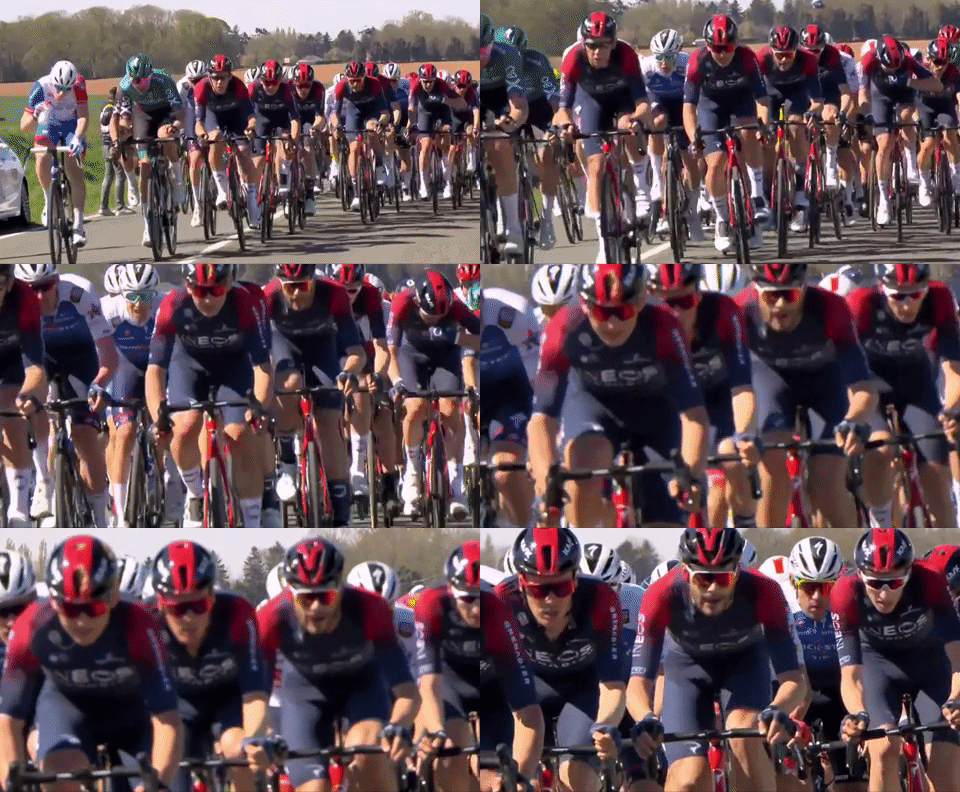
The ticker still showed more than 210 km when all hell broke loose. Michał Kwiatkowski seemed to be the instigator who made his team split the race in two. The trio in front was eaten up in no time and it was only a few kilometers before the narrow gap between the two main groups became a chasm.
The entire Ineos Grenadiers line-up made the cut and although they had the help of a few others, the British team put every man at the front of the pack.
Up front and out of danger? Or too soon too much?
For several kilometers, most of the team stayed there, pulling the rubber band to the point where they hoped it might break. The gap grew to around 1:30 with the help of TotalEnergies, Bora-Hansgrohe and others before anyone really got the situation under control as they approached the first paved sectors.
Round 2: Bottleneck
The number one Ineos Grenadiers driver was Filippo Ganna, a man who was tapped into some sort of glory between Paris (Compiègne) and Roubaix. He had handed over draft duties to veteran Cameron Wurf on entering the first cobbles before getting back into the fray, but a front tire failure soon put him out of the running.
A wild chase ensued. By the time Ganna had a puncture his group had stretched into a long and brittle line on the dusty pavement while the second large group was chasing, 1:13 back. But with their Italian stallion stuck between the two groups, the lead Grenadiers seemed to slow the pace. As the race reached the final 150km, Ganna grabbed the rear of the lead group after three kilometers in the time trial.
He was back but as he worked his way up the chase with Mathieu van der Poel, Wout van Aert and the other favorites was just 35 seconds behind.
Then something happened that could be described as bad luck, but which kept the chasing group at a distance for a little longer. The pointed end of the first group, which contained most of the Ineos Grenadiers, managed to find a muddy patch of mud on the Saint Python sector that sent them sliding across the cobblestones, blocking the road and putting a lone rider in the lead .
 We’re interrupting your regularly scheduled broadcast with a traffic update…
The British team still had three key men in the running and the silver lining of the crash was that the resulting bottleneck added a minute to the gap the favorites needed to close.
Round 3: Mohorič makes his inevitable move
Niki Terpstra (TotalEnergies), winner of Paris-Roubaix 2014 after a late solo attack, led the race through the dust for around 10km before regrouping. After another solo acceleration by Jens Reynders (Sport Vlaanderen-TopSport) and more punctures, the next big movement was waiting until 111 from the finish.
It was only a matter of time before Milan-Sanremo winner Matej Mohorič (Bahrain-Victorious) put his nose in the wind. After crouching 100km safe and sound in the middle of the front crevice, the Slovenian national champion decided on the right move to follow 15km from the Arenberg ditch.
 Mohorič joined Casper Pedersen (DSM), Laurent Pichon (Arkéa Samsic), Tom Devriendt (Intermarché-Wanty-Gobert Matériaux) and Davide Ballerini (Quick-Step Alpha Vinyl) in one of the most significant attacks of the day.
It wasn’t the winning move, but it was crucial and with the iron Mohorič in there, it put everyone behind behind while the five in front held the line over the dusty cobbles.
Less than 10km after the quintet jumped clean, the favorites finally made it back to the back peloton and when the attackers entered the Trouée d’Arenberg the gap was less than two minutes with two pursuers stuck in between.
Lap 4: Van Baarle takes the lead
 Van Aert, Küng, Van Baarle and Van der Poel are waiting for someone to fall, Laurent Pichon is holding on behind them.
With 50km to go, you could say that Dylan van Baarle has done too much work. But it was his attacks and the weight of his team’s combined effort right from the start that made the race through the final 60km.
The Arenbergwald and the following sectors had their typical influence on the race, forcing a selection and exposing every weakness. Van Aert still had Nathan van Hooydonck and Van der Poel had Merlier, but with numbers on his side – and no clear leader – Van Baarle gave his rivals the first sign of trouble with around 55km to go.
 Tom Devriendt, seen here ahead of Mohorič and Pichon, gained many fans en route to Roubaix and eventually finished fourth.
With Mohorič, Devriendt and a tiring Pichon still almost a minute ahead, Van Baarle started his attacks. He ate a halfway lead before finding himself back in the company of Van Aert, Van der Poel and Küng. He was soon joined by Lampaert, Jasper Stuyven (Trek-Segafredo), Adrien Petit (Intermarché-Wanty-Gobert Matériaux), his British team-mate Ben Turner and Mohorič, who fell behind after suffering a puncture.
The drivers without teammates attempted a few accelerations, but Turner’s presence gave Van Baarle a card up his sleeve. Only Lampaert and Mohorič gained ground – the pair would go ahead with Devriendt – but no one else was granted daylight.
With just 20 seconds left of the race and two riders wedged in, Turner attacked the elite chasing group with 30km to go. Van Aert quickly caught up with the 20-year-old neo-pro and as the group caught their breath together Van Baarle fell from behind and they watched him disappear down the road.
 There he goes…
Van Baarle had moved into the lead of the race with 25km to go, the gap was now over 35 seconds. He dealt his final crushing blow just five kilometers later, almost by accident, it seemed, when he rolled off the front line in the four-star Camphin-en-Pévèle sector.
 go go gone
From there, Van Baarle’s gap grew from a handful of seconds to a devastating 1:47 at the finish line at the Roubaix Velodrome, where he celebrated a famous and long-awaited Paris-Roubaix victory for the Dutchman and his team.
As the dust settled, it became clearer how dominant he and his team had been. The Ineos Grenadiers didn’t emerge with a clear leader but all seven riders gave it their all throughout the day and the result was everything they had hoped and planned for.
 A big day for the Brailsford’s Boys.